Monday, 17 November 2014

Pecan Toffee Chocolate Cake


We were out for dinner again this weekend, and guess what I was asked to bring? Yes, dessert again. Of course, I have to try something new...I had 3 pears that I was going to use, but when I cut them open, they were not very nice on the inside, all brown and mushy. So the upside down pear and chocolate cake turned into a pecan toffee chocolate cake!

Instead of pears, I used the pecans that I had. This also allowed me to use up some cocoa; when my daughter moved back home she brought a lot of cocoa with her!

The toffee soaked into the cake and then set into a chewy, gooey layer...combined with the crunchy pecans and some whipped cream, it all made a nice contrast to the soft warm cake.


Start by lightly greasing a 10" springform pan, and lining the outside with tinfoil, to catch any bits of toffee that might ooze out. Place the pan on a tray.

Now you have double protection from toffee drips on the bottom of your oven!


Melt 3 ounces of butter and pour it into the prepared pan. Tilt the pan to swirl the butter around so that it is evenly distributed.


Sprinkle 3/4 cup brown sugar, as evenly as possible, over the butter.

Then drizzle 1/4 cup of honey over the brown sugar.


 Now place 1 cup of pecan halves over the brown sugar and honey. There is no need to arrange them perfectly, just make sure they are evenly spaced.

Set the pan aside while you prepare the cake batter.


In the bowl of a stand mixer, using the paddle attachment, cream:

4 ounces of soft butter
1 1/2 cups white sugar

As the ratio of sugar to butter is quite high, this takes a while to become light and fluffy. Scrape the bowl down occasionally.


Heat the oven to 350F.


While the butter and sugar are creaming, sift the dry ingredients together:

1 cup  + 1 1/2 tablespoons flour
1/2 cup cocoa
1 teaspoon baking soda
1/2 teaspoon salt
2 good pinches of cayenne pepper


When the butter and sugar have become light and fluffy, add:

3 eggs, one at a time, scraping the bowl down in between each addition.


Add one third of the dry ingredients, and mix on low speed until just combined.


Measure out the wet ingredients:

1/4 cup plain yoghurt
3/4 cup milk
1 teaspoon vanilla

Add half of this to the batter and mix until just combined.


Add another third of the dry ingredients, then the remaining wet ingredients and lastly the remaining dry ingredients. When this has been fully incorporated, scrape the batter into the pan, on top of the pecans.


Using a spatula, or the back of a spoon, carefully spread the batter evenly across the nuts, being careful not to disturb them.


Bake in the 350F oven until the cake is set in the centre, and springy to the touch, about 30 - 40 minutes.


Remove the cake from the oven, and immediately run a sharp knife around the edges of the cake.

Invert the cake onto a plate or tray, and leave it to sit for about 5 minutes, before carefully removing the pan.

Allow the cake to cool before cutting.


                Serve the cake at room temperature, with softly whipped cream, or ice cream.


  • As I mentioned at the start of the post, this was originally intended to be a pear and chocolate upside down cake, which I still want to make. If you choose to use fruit instead of nuts, try thinly sliced pears; pitted and halved cherries; thinly sliced peaches or plums; fresh cranberries; sliced fresh rhubarb.
  • Any type of nut, or combination of nuts, will work for this cake.
  • Go wild, and use a combination of fruit and nuts... pear and almonds; peaches and pecans; cranberries and pistachios.
  • You can use corn syrup or maple syrup if you don't have honey.
  • The spices added to the dry ingredients for the cake batter can be omitted, or changed. Other spices, or flavours that will work well include cinnamon; coffee (use 2 tablespoons of strong coffee in place of some of the milk); cardamom; ground ginger, and adding a bit of grated fresh ginger to the butter and sugar while it's creaming; almond extract instead of vanilla; grated orange zest; Chai or Earl Grey tea can be used to flavour the milk before adding it to the batter.
  • If you are using salted butter, use half the amount of salt for the batter.
  • You can use buttermilk as your liquid, instead of yoghurt and milk. I had no buttermilk...you can also use sour cream instead of yoghurt along with the milk. Part of the milk can be switched to strong coffee (see above) or orange juice.
  • It is important to let the cake sit in the pan for 5 minutes, to allow the caramel to set a bit, as well as to soak into the top part of the cake. It is equally important to remove the pan as soon as you can after this resting period...once the caramel has cooled down completely it becomes harder to remove the pan. If this happens, place the pan back into a warm oven for a couple of minutes, to soften the hardened caramel. Remove the pan immediately.
  • Store the cake at room temperature.
  • Turn this into individual cakes, by dividing the butter, brown sugar, honey and pecans amongst 12 muffin cups, then spreading the batter over the top and baking them. Remove from the muffin tins after about 5 minutes, by inverting it over a tray.
  • This can also be baked in a 9" X 13" pan.

Thursday, 13 November 2014

Fettucini with Chicken, Asparagus, Red Peppers and Blue Cheese


This dish was a classic "What's in the fridge?" meal...I was planning on using the last 2 chicken breasts from the freezer, and pulled all the bits and pieces from the fridge. The result was a delicious pasta, with asparagus, red peppers and leeks in a roasted garlic broth, topped with pinenuts and blue cheese. Time to go grocery shopping!


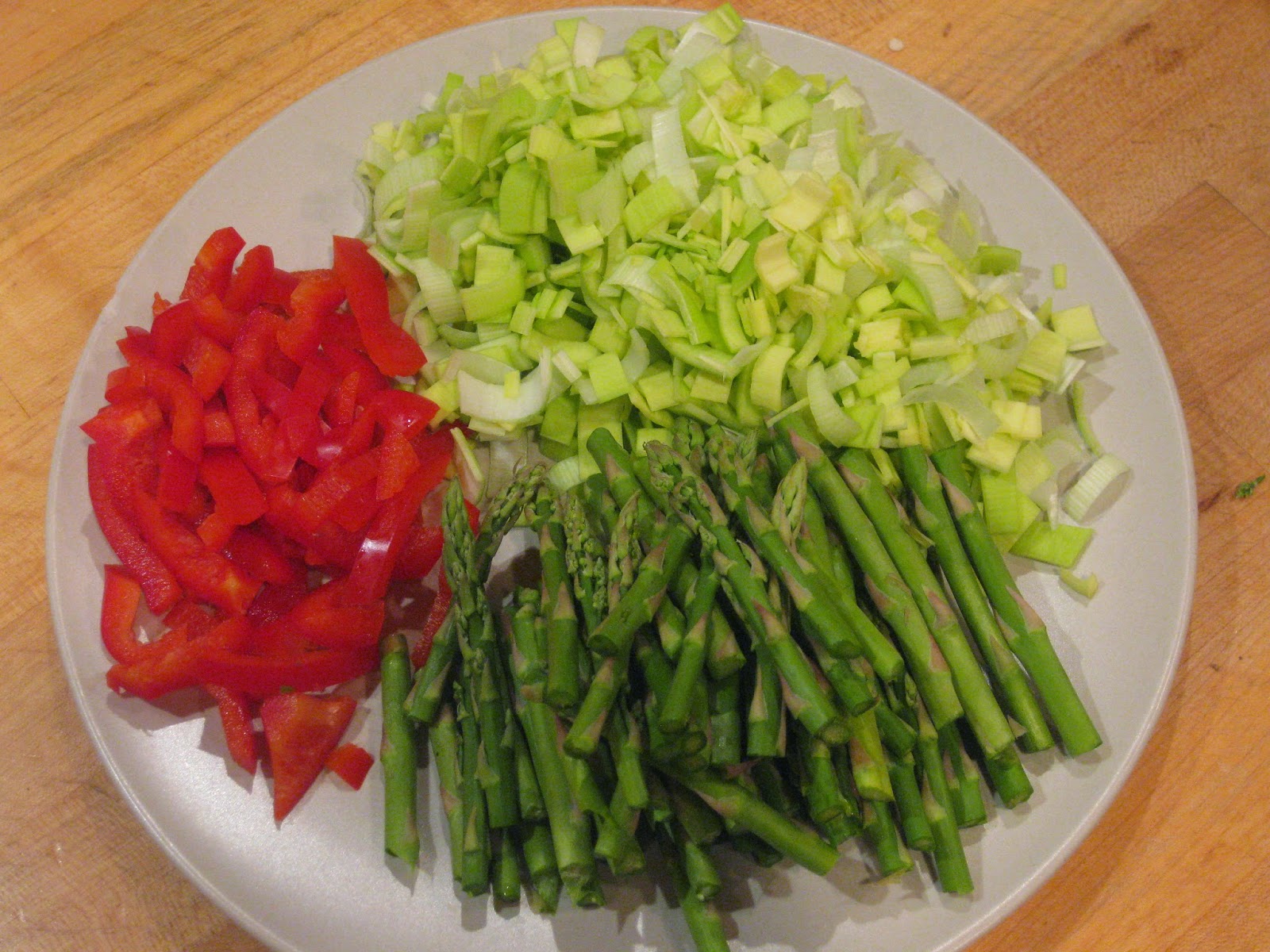
The partial red pepper, leek and the last few spears of fresh asparagus were the inspiration for this pasta dish.


Finely slice the leek and red pepper.

Cut the asparagus into 2" pieces, and set aside until later.


I grated the last bit of Parmesan, and crumbled the last small piece of blue cheese.

Save the Parmesan rinds for the sauce.


Dice about 1/4 cup of sundried tomatoes.

I had roasted the last 2 bulbs of garlic earlier in the day. Remove the skins and roughly chop the garlic.


Put a large pot of salted water on to boil for the pasta. Cut the 2 chicken breasts into 1" dice.


In a hot pan with a bit of olive oil, quickly sear the chicken, seasoning with salt and pepper.

Remove from the pan, and set aside until the sauce is ready.


In the same pan, cook the leeks and red peppers in a bit of olive oil, until the leeks start to soften.

Season lightly with salt and pepper.


Add in the diced sundried tomatoes and roasted garlic. Stir to combine, making sure the roasted garlic paste is well distributed.

Now add the reserved Parmesan rinds, and enough chicken stock to cover the vegetables.

Simmer until the stock reduces and you are left with a sauce thick enough to coat the cooked pasta. Add more stock if needed.

You are aiming for cooked vegetables, and melting Parmesan rinds. You can make as much, or as little, sauce as you like.


Return the seared chicken to the sauce, and continue to simmer until the chicken is fully cooked, adding more chicken stock as needed.

Taste and adjust the seasoning.


Cook the pasta in the salted, boiling water, adding the asparagus to the pot for the last minute. Drain the pasta and asparagus and return to the cooking pot. Add the sauce to the pot, and toss to coat the pasta with the sauce...remember to remove the Parmesan rinds before serving!


Sprinkle the pasta with toasted pinenuts, grated Parmesan and crumbled blue cheese.


  • The Parmesan rinds add richness to an otherwise light sauce. I never throw mine out, but keep them for pasta sauces or stews.
  • Any cheese will work with this dish...goat cheese, asiago, bocconcini or feta.
  • Salt the sauce lightly and adjust it at the end. A lot of the components are salty: the sundried tomatoes, Parmesan rinds, chicken stock. Remember, it's easier to add than to take away!!!
  • If you don't have leeks, any member of the onion family will do...shallots, onions, green onions.
  • If my last red pepper was whole, I would have roasted it. This would have added a sweetness to the sauce.
  • Olives would complement everything really well.
  • If you like things spicy, add a pinch or more of chili flakes to the sauce.
  • The roasted garlic paste combines with the chicken stock to make a light, creamy sauce. If you want a richer sauce you can add whipping cream, or stir a soft cheese such as cream cheese, goat cheese or blue cheese into the stock; it will melt and make a richer sauce.
  • To toast the pinenuts, place them in the dry frying pan before cooking the chicken, and cook them over a medium low heat, stirring often until they start to colour. Remove from the heat and set aside. This saves turning the oven on if you forgot to toast the nuts when the garlic was roasting, as I did.
  • The pinenuts, or any other soft nut such as walnuts, can also be crushed and added to the sauce with the roasted garlic. This will add richness and texture to the sauce.
  • Add fresh herbs, such as basil, parsley, chives or rosemary.
  • Shredded fresh spinach placed on top of the hot pasta as a garnish, will wilt down and become part of the dish.
  • This sauce can be made without meat, or with fish, prawns or scallops.
  • The vegetables can be prepared the day before; the garlic and nuts can be roasted a couple of days ahead when you have the oven on for something else.

Tuesday, 11 November 2014

Sole Fillets with Asparagus, Grape Tomatoes and Avocado


There was fresh asparagus in the fridge which I wanted to use, as well as a few grape tomatoes, half an avocado and a lemon. It's been a while since we had fish, so that was my choice. The asparagus was crisp, the tomatoes were hot, juicy and sweet and the avocados were cold and buttery; it all contrasted well with the silky tartness of the tartar sauce.

I also cooked up some brown rice, with minced leeks, fresh thyme, garlic and a bayleaf for flavour.

Everyone in the house loves tartar sauce, so it was expected that I make some for the fish!


For the tartar sauce, combine:

2 tablespoons minced green onion
2 tablespoons minced dill pickles
2 tablespoons capers, roughly chopped


Add:

2/3 cup mayonnaise
a few drops of hot sauce

Mix well to combine. Taste and adjust seasoning with salt, pepper and lemon juice.

Chill until needed.


For the fish, pre-heat the oven to 350F.


For the fish seasoning, combine:

1 clove garlic, minced
1 teaspoon grated lemon zest
1 teaspoon chopped fresh thyme
1/2 teaspoon salt
1/4 teaspoon black pepper


Pat the sole fillets dry with paper towel. This is important if the fish was previously frozen, as mine was.

Divide the lemon thyme seasoning between the fillets (I used 9 pieces of sole), rubbing it onto the skin side of the fish.


Lay 3 asparagus spears across each piece of fish.


Starting at the tail end, roll the fish up around the asparagus, and place the rolls in an ovenproof dish, leaving a bit of space between each roll.


Cut the grape tomatoes in half. I had about 1 cup of tomatoes.

Place them around the fish in the dish.

Sprinkle the fish and tomatoes lightly with salt and pepper, and drizzle with a bit of olive oil.


Bake the fish and tomatoes for about 20 minutes. The fish will be firm, the asparagus will be roasted, but still crisp and the tomatoes will be softened.

Serve 3 rolls per person, topped with the roasted grape tomatoes and diced avocado, and accompanied by the tartar sauce.


  • Sole is a good choice for pairing with strong flavours. The mildness of the fish allows the other flavours to shine through.
  • The tartar sauce can be brightened up with the addition of lemon zest and chopped fresh parsley or chives.
  • Fish that has been frozen has more water in it than fresh fish; that is the reason for drying the fillets with paper towel.
  • The fish seasoning can be altered to suit your tastes, or the ingredients you have available. Some suggestions are: fresh chives or parsley; minced shallots; cayenne pepper; minced capers or olive tapenade.
  • If you prefer your asparagus on the softer side, blanch and cool the spears before placing them in the fish.
  • Instead of asparagus, try broccoli florets or roasted red peppers.
  • If you are using a fish that is thicker than sole and therefore not easy to roll, lay the fish flat in the dish, rub with the seasoning and place the vegetables on top. Drizzle with olive oil and bake.
  • Instead of tartar sauce, make a lemon-white wine butter sauce. Add 1/2 cup white wine to the baking dish with the fish. When the fish is cooked, keep it warm while you finish off the sauce: place the liquid from the baking dish into a frying pan along with the juice of 1 lemon, bring to a boil and reduce by half. Then quickly whisk in 3 tablespoons of cold butter, that has been cut into small pieces. Taste and adjust seasoning.
  • The fish rolls can also be baked on a bed of thinly sliced vegetables, such as onion, leek, red pepper and carrot, with garlic and fresh herbs. These vegetables will flavour the fish, as well as create a lovely accompaniment for serving with the fish.
  • If you have leftover cooked fish such as salmon or crab, combine it with chopped cooked spinach, minced shallots, lemon zest and chopped fresh thyme. Add a bit of cream cheese or soft goat cheese to bind it and give a creamier consistency if you like. Use this as your stuffing.

Sunday, 9 November 2014

Turkey Roulade Stuffed with Ground Turkey


The package of turkey scallopini in the freezer was too small to feed everyone, and so was the package of ground turkey. I decided to use both, and came up with this meal. The ground turkey was combined with scallions, breadcrumbs and spices and was used to stuff the scallopini, roulade style.


In a bowl, combine:

2 green onions, thinly sliced
2 cloves garlic, minced
1/2 teaspoon paprika
1/2 teaspoon salt
1/2 teaspoon ground black pepper


Add:

1 egg
3/4 cup breadcrumbs
12 oz ground turkey

Mix well to combine. The stuffing is ready.


Place a piece of parchment paper on the counter, and lay the pieces of turkey scallopini on it, overlapping slightly, to form a rectangle of about 12" X 8".


Gently press the stuffing evenly across the scallopini, leaving a half inch border around the edge.


Using the parchment paper to help, roll the meat up along the long side, carefully pressing it tightly together as it rolls.


Using kitchen string, tie the roulade evenly down the length to help hold it's shape while it bakes.


Sear the roulade in a hot pan, using olive oil to prevent sticking.

Brush the top with a spicy jelly, such as red pepper.

Place in a 350F oven and bake until the turkey is cooked through.


Allow the meat to rest for 5 minutes, before removing the string, and slicing.


  • Both packages of meat were about 12 ounces, and this fed 4 people comfortably.
  • The roulade can be baked with chicken stock or juice in the bottom of the pan, to provide moisture, and to be used for making sauce or gravy.
  • I used a peach and chipotle jelly; any sweet and spicy jelly will work. Mustard can also be used instead.
  • The stuffing can be changed to a traditional bread or sausage stuffing, with or without dried fruit; leftover cooked rice combined with the ground turkey, instead of breadcrumbs will also work well; a vegetable based stuffing of breadcrumbs, spinach, onions and herbs is also tasty.
  • I used green onions, as they were the last 2 in the fridge, and I wanted to use them up. I would normally use finely minced onion. Thinly sliced leek, cooked to soften it, makes a good stuffing ingredient as well.
  • If you are using dried fruit, consider soaking it in juice or liqueur before adding it to the stuffing, adding another layer of flavour.
  • If you have pork loin, start cutting along the long side, slowly unrolling the meat as you cut, until you have formed a rectangle of pork meat. Substitute ground pork for the turkey, and proceed with the recipe.
  • The roulade can be assembled ahead, and kept well wrapped in the fridge, or frozen until another day.

Thursday, 6 November 2014

Braised Chicken Thighs with Capers, Raisins and Shallots


This meal is a favourite of ours, and when I realized I had 3 stalks of celery, some shallots, half a can of tomato paste and some open beef stock to use up, this came to mind. And yes, I did say beef stock, even though it is a chicken recipe. Somehow it works, adding a lovely richness to the sauce.

Start off the day before , by marinading the chicken thighs. I use boneless, skinless thighs, you can use bone-in thighs if you wish. The bone will add more flavour to the sauce, we just prefer not having to deal with the bones!


 Place the marinade ingredients in a large ziploc bag. You will need:

3/4 cup dry red wine
3 stalks of celery, sliced about 1/2" thick
4 - 5 shallots, peeled and cut into 4 - 6 pieces (depending on the size of the shallot)
1/3 cup dark raisins
1/4 cup capers
2 teaspoons chopped fresh rosemary
2 teaspoons chopped fresh sage


Add 10 boneless, skinless chicken thighs and seal the bag, squeezing out as much air as you can.

Leave to marinate in the fridge overnight.


Remove the chicken thighs from the marinade, reserving the marinade to make the sauce.

In a hot pan, with a drizzle of olive oil, brown the chicken thighs.

Remove them from the pan, and set aside.


Add the reserved marinade to the pan, and bring it to a boil.


Now add in:

1 cup beef stock
1/4 cup of tomato paste
1/2 teaspoon salt
!/4 teaspoon ground black pepper


Once the liquid is boiling again, return the browned chicken thighs to the pan.

Turn the heat to low, cover and simmer until the chicken is tender, about 1 hour.


Remove the lid, skim off any excess fat, taste and adjust seasoning.


I like to serve this chicken over soft polenta, but it is also yummy over noodles or rice.


  • This recipe is perfect for a slow cooker. After marinating the chicken, place all the ingredients into the slow cooker, and leave it to do its job. Browning the chicken adds some flavour, but is not an essential step.
  • Onions, cut into large dice, or leeks can be substitutes for the shallots.
  • Add olives to the sauce, for another dimension.
  • Chopped dried apricots or figs can be used instead of the raisins. I prefer dark raisins, but golden raisins can also be used. 
  • If you use dried herbs, you only need 1 teaspoon of each.
  • The chicken can be placed in the marinade and then frozen, to be defrosted and cooked whenever you are ready.
  • The beef stock in the recipe allows you to use other meats, such as beef short ribs or a pot roast. The cooking time will need to be adjusted, as these will take longer to cook than the chicken thighs do.
  • Other vegetables can be added to the sauce. Diced carrots, zucchini or sliced mushrooms can be cooked in the pan until starting to soften, after the chicken has been removed. Add the marinade, tomato paste and stock, replace the chicken and allow it all to braise.