Monday, 15 June 2015

Penne with Chicken, Prosciutto, Asparagus and Goat Cheese


Time to use up some chicken tenders again! I was in the grocery store a couple of days ago and bought 8 thin slices of prosciutto, with no real idea of what I was going to use them for, but knowing they wouldn't go to waste. The prosciutto was perfect to use with the chicken; add in some asparagus and a bit of goat cheese and you have a lovely light pasta dish.

For the sauce I used the roughly quarter cup of white wine that was left in the bottle, and the open chicken stock that was in the fridge.


Bring a large pot of lightly salted water to boil. When it is boiling, add the penne; prepare the sauce while it is cooking.


In the pan that you will be making the sauce, dry roast some pinenuts for a garnish.

Use a medium low heat, stirring them often, as they burn very easily.

Remove the pinenuts and set aside until needed.


Prepare the sauce ingredients:

Mince 2 cloves of garlic
Dice the 8 thin slices of prosciutto
Chop 1 tablespoon of fresh basil
Cut asparagus into 1" lengths, about 1 cup
Cut the 8 chicken tenders into 1" cubes


Heat the pan and add a drizzle of olive oil.

Cook the chicken, seasoning with salt and pepper, until it is cooked about 3/4 of the way through.

Remove and set aside until needed.


Add the chopped prosciutto to the pan, and cook for a few minuted until it starts to crisp up slightly.

At this point add the minced garlic, and cook for a minute. Be careful not to burn the garlic.


Add the white wine; I had about 1/4 cup.

Cook until it is almost all reduced away.


Add chicken stock to the pan. The amount can be adjusted to suit your preference.

I used about 1 cup.

Bring to a boil.


Add the chicken back to the pan, and allow it to simmer in the sauce until fully cooked.

Add more stock if you feel you need it. You can also add some of the pasta cooking water; the
starch in it helps to slightly thicken the sauce.


When the pasta is almost cooked to your liking, add the asparagus to the pot and allow it to cook briefly, before draining it all together.

Return the cooked pasta and asparagus to the pot.


Add a handful of grated Parmesan and the chopped fresh basil to the sauce. Stir it in and allow it to melt.

Taste and adjust seasoning.


Add the sauce to the pasta and asparagus, mix well to combine.


Serve, garnished with the toasted pinenuts and crumbled soft goat cheese. I also used a slightly stale baguette and some garlic basil butter to make some toasted bread to serve alongside the pasta.


  • A light sauce like this is perfect for the hot weather we are having right now; you can add whipping cream or Basic Tomato Sauce (or a bit of both) if that is your preference, or to give you a slightly heartier sauce in colder weather.
  • This sauce is flexible; add as much or as little chicken stock and/or pasta cooking water as you like to give you the consistency you like. There is no right or wrong.
  • Remember that the prosciutto, Parmesan and chicken stock can all be salty, so keep that in mind when seasoning in the beginning. You can always add more salt if you need it at the end.
  • No prosciutto? It can be omitted, or it can be replaced with bacon, pancetta or ham.
  • I had 8 chicken tenders; 1 chicken breast would be the equivalent. Leftover cooked chicken can also be used.
  • Seared scallops or prawns would be a nice substitution for chicken. Chick peas could be added if you are omitting the meat.
  • If you like a spicier sauce, add chili flakes. Rosemary or Italian parsley would also be good choices for this sauce.
  • The white wine can be omitted; use extra chicken stock or pasta cooking water. I used the wine because I had some.
  • As far as cheeses go, the goat cheese adds a tanginess to the sauce, and as it melts into the sauce it adds a creamy consistency. Other cheeses that would work for either tanginess or creaminess include feta, blue cheese, bocconcini, cream cheese, Asiago or fontina.
  • Cherry tomatoes can be added to the sauce. For a light sauce like this I like to cut them in half and marinade them with salt, pepper, the chopped fresh basil and a couple of tablespoons of balsamic vinegar. Add them into the pasta at the same time as you add the sauce.
  • If you have grilled vegetables, sundried tomatoes, olives, artichoke hearts, roasted red peppers or fresh spinach these would add a lot to the sauce. If I am adding fresh spinach to pasta, I like to finely shred it and place it on top of the hot pasta right before serving. It starts to wilt and becomes almost like a warm spinach salad along with the pasta. It can also be mixed in with the sauce; the heat from the pasta and sauce will cook the spinach immediately.

Thursday, 11 June 2015

Grilled Potato Salad


This salad came about in an effort to use the baby red potatoes and some leftover  Roasted Garlic Vinaigrette.

I was grilling chicken and decided to make a grilled potato salad, using the vinaigrette on the warm potatoes, which maximizes their absorption of it, increasing the flavour.


Start off by parboiling the whole potatoes i n lightly salted water.

When the potatoes are just tender enough to easily poke a skewer or fork through, drain them and rinse them under cold water to stop them from overcooking.


Return the drained and cooled potatoes to the pot, and season with salt and pepper. Add enough olive oil to lightly coat the potatoes.


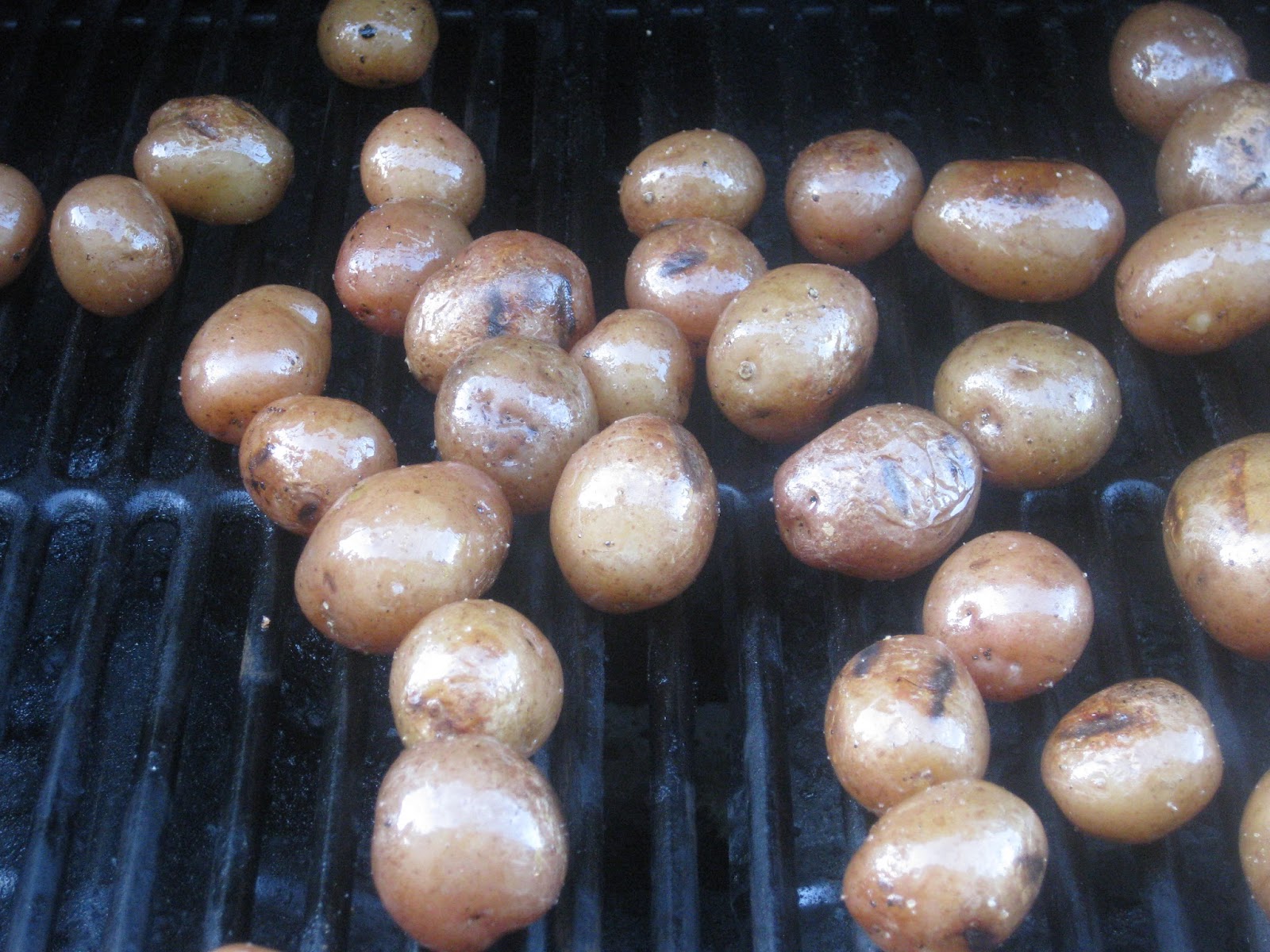
Put the potatoes directly onto a hot barbecue, and allow to cook, turning occasionally, until tender and lightly charred on the outside.


While the potatoes are grilling, chop:

1 tablespoon of fresh rosemary

Place this into a bowl large enough to hold the potatoes, and still be able to toss them with the dressing.


Remove the potatoes directly from the grill to the bowl with the chopped rosemary.

Add enough Roasted Garlic Vinaigrette
to coat the potatoes, mixing gently so that the potatoes don't get crushed.


Allow the potatoes to cool before serving. Biting into a hot potato is not a fun experience!

 I served the salad at room temperature, but it is just as good cold.


As I had not used all of the potatoes to make the salad, there were quite a few leftover, but those were used up the next night on pizza. I used the 2 pizza crusts and some pizza sauce that was in the freezer, the shallots and the potatoes, as well as the last of the feta cheese.


I bought 2 chicken and roasted red pepper sausages, removed the meat from the casings, and cooked it. The shallots were thinly sliced and caramelized. The potatoes were sliced and the feta was crumbled.


Spread a thin layer of pizza sauce over the pre-baked crust.

Spread the shallots over the sauce and top with the sliced grilled potatoes.


Add a layer of the cooked, crumbled sausage


Top with a final layer of crumbled feta cheese.

Place into the oven and bake until heated through. Slice and eat!


  • The Roasted Garlic Vinaigrette   has a lovely tang to it from the apple cider vinegar, but also quite a bit of sweetness from the honey, apple juice and roasted garlic. This gave an interesting twist to the potato salad, and these flavours still came through on the pizza.
  • Use grainy mustard instead of just Dijon when making the dressing and you will add texture and that extra bite from the mustard seeds.
  • The vinaigrette can be made and kept in the fridge for 2 - 3 days, and can be used not only as a salad dressing (it's really nice with spinach salad), but also as a dip for things like chicken strips and as a marinade for chicken, fish or pork before grilling.
  • I opted not to cut my potatoes in half as they were reasonably small, but if you have larger potatoes, cutting them makes them easier to eat. More dressing will also be absorbed...but by the time they were finished on the grill the skin had split nicely, allowing the dressing to penetrate.
  • Leftover potatoes can also be used to make hash and egg for breakfast or lunch; they can also be roasted or mashed.
  • Adding the hot potatoes to the rosemary brings out the oils in the herb. Any herbs can be used, try basil, chives, parsley or thyme.
  • Add other vegetables if you like...chopped green onions, diced red peppers, grated carrot, diced pickles, green peas. Think of the sweet, sour contrast when choosing what you will add. Chopped or sliced hard boiled egg can be added just before serving.
  • If you don't have the time to make the vinaigrette, a simple oil and vinegar will work, as will a store bought dressing.
  • Instead of placing the potatoes straight onto the grill, put them on skewers, alone or with other vegetables.
  •  

Monday, 8 June 2015

Lemon Herb Grilled Chicken Thighs


These chicken thighs were a way for me to use up some of the excess lemons that were in the fruit bowl. I think I kept forgetting that there were lemons in the house , and bought more each time I went to the store!

The lovely, hot, summer-like weather we are having has prompted a lot of growth in the herb garden, so some fresh picked herbs, as well as the chopped parsley I had in the fridge went into the marinade as well.

The beautiful weather has also encouraged the use of the BBQ and eating out on the patio. Potato salad, grilled red peppers and a yoghurt-cucumber and feta cheese sauce completed the meal.


The fresh herbs...chives, thyme, rosemary and oregano, along with the lemon and some fresh garlic.

Time to make the marinade.


Finely chop the herbs, the amount depends on what you have. I had about 1/3 of a cup altogether, including the chopped parsley that was in the fridge.

Peel and slice the garlic. I used 3 cloves.

Finely grate about 1 teaspoon of lemon zest.


Place everything into a bowl large enough to hold the chicken thighs. I had 9 thighs, boneless and skinless.

Add:

1/2 teaspoon salt
1/2 teaspoon black pepper
2 tablespoons olive oil
juice of the lemon that you zested


Add the chicken thighs, turning them to coat them all over.

Cover with plastic wrap and refrigerate for 4 - 6 hours.


Cook the chicken thighs on a hot grill, turning often, until cooked through.


  • If you have bone in chicken thighs allow extra time for cooking. They are denser than the boneless thighs, but the bone does help to keep the meat from drying out as well as adding flavour.
  • Chicken breasts or whole chicken can also be used. Cut the whole chicken in half along either side of the back bone, removing the bone at the same time as creating a flatter piece of meat that will cook in less time. You can also cut along the breast bone and create 2 separate halves.
  • If you are able to buy Cornish game hens, these are nice to use for a change from chicken. They are smaller (you can serve one per person), have a better meat to bone ratio and a more delicate taste. They are, however, pricier. 
  • If you are marinating bone in chicken, leave the meat in the marinade for longer, even overnight.
  • The herbs give a nice brightness to the dish, and with the abundance of fresh herbs that are available in my garden, or in grocery stores, why not make use of them? The lemon zest also contributes to the lightness of the dish, which is perfect for summertime.
  • The lemon can be changed to lime or orange if you like. Balsamic vinegar can be used instead of lemon juice.
  • The chicken can be pan seared and then roasted to finish cooking.
  • The yoghurt, cucumber and feta cheese was creamy and cool, a nice contrast. Use tzatziki if you have it. It also allowed me to use the last of the Greek yoghurt, and the last baby cucumber.
  • Instead of serving it with salad and/or vegetables, serve the chicken thinly sliced on top of salad, risotto or pasta. Cut chicken breast into cubes and marinate, then put onto skewers. This would be nice served with warm flatbread such as pita or tortillas to wrap it in, along with shredded lettuce, diced tomatoes and tzatziki.
  • If you are using fish, don't marinate it, but use the marinade to brush onto the fish while it grills (or bakes). Skewered jumbo scallops and prawns would be really nice with this marinade. When you skewer them, place them on a tray with the prawn wrapped around the scallop. Then slide the skewer through both. This presentation looks impressive, and everybody will have both prawns and scallops in equal amounts. Then grill them, basting with the marinade.
  • Make extra chicken and freeze it. Use this next time you make something like Grilled Chicken, Spinach and Artichoke Lasagne.


Sunday, 7 June 2015

Wholewheat Almond Waffles


Sunday breakfast, waffles on the menu. Making waffles is usually my husband's breakfast treat for the rest of us, but as he was mowing the lawn before it got too hot out there, I made them this time.

I played with the basic recipe a bit, taking the opportunity to use some of the ground almonds that I had found in the cupboard a few days ago. I also exchanged some of the all purpose flour for wholewheat flour, without sacrificing any of the crispy outside, fluffy inside of the waffles.


Start by plugging your waffle iron in to heat up while you make the batter. The hotter it is when you pour the batter on, the crispier the waffles will be.


Measure the dry ingredients into a large bowl:

1 1/2 cups all purpose flour
1/2 cup wholewheat flour
1/3 cup ground almonds
1 tablespoon baking powder

Whisk together to blend.


Measure the wet ingredients in another bowl or large jug:

2 cups milk
1/3 cup vegetable oil
1 teaspoon vanilla
2 egg yolks (save the whites)


 Place the 2 egg whites into the bowl of an electric mixer, and whip to firm peaks. Set aside.


Whisk the wet ingredients to break the egg yolks up and blend everything.

Add the wet ingredients to the dry, and whisk until combined.


Scrape the whipped egg whites out onto the batter, and using a rubber spatula, gently fold them into the batter.


The batter is now ready for cooking. It should be thin enough that it can be ladled or poured onto the waffle iron, but still fluffy from the egg whites.


Using a ladle, pour the appropriate amount of batter onto the hot waffle iron. Close and allow it to cook.


I like my waffles quite golden and crispy; cook the waffles to suit your preference.


Remove the waffle from the waffle iron, place on a plate and top with fresh fruit, passing maple syrup at the table.


  • Waffles are a weekend breakfast treat, and usually we just use the basic recipe...use 2 cups all purpose flour, omit the almonds and vanilla. This gives us the flexibility to customize the waffles as they are cooked. Simply pour the batter onto the waffle iron, then sprinkle on your favourite addittions, be it fruit or nuts, and bake. Everyone is now happy!
  • This recipe allows for a lot of adjusting...make buttermilk waffles by using half milk and half buttermilk; use 1/2 cup of plain yoghurt or sour cream to replace some of the milk; use juice, eggnog or Chai for all or part of the liquid.
  • If you want to use wholewheat flour try and not use more than half of what the recipe calls for, as you can end up with a very heavy waffle. Fold oats, flax seeds or chia seeds into the batter before cooking the waffles.
  • It is important that you fold the egg whites into the batter very gently, deflating them as little as possible. The baking powder plays a large role in making the batter rise during cooking, but the whipped and folded egg whites help too, giving you a light and fluffy waffle.
  • Melted butter or margarine, olive oil or nut oils such as peanut or hazelnut can be used instead of vegetable oil.
  • Orange or lemon zest; spices such as cinnamon, ginger, nutmeg or aniseed; vanilla or almond extract; instant coffee dissolved in a bit of hot water; liqueur or rum; chopped fresh herbs or ground black pepper can add a whole new dimension to your waffle experience.
  • Things to fold into the batter can be as simple as fresh or frozen berries, chopped fresh fruit or nuts, chocolate chips, diced cooked bacon or ham.
  • Top the waffles with flavoured butters, maple syrup, chocolate sauce, ice cream, custard or whipped cream for sweet options.
  • Savoury options include ham or bacon and soft cooked eggs; chicken and gravy; pulled pork.
  • Waffles are best eaten right away, but can be kept warm in a low oven, or re-heated by placing them back onto the hot waffle iron or into a toaster.
  • Waffles have the flexibility to be breakfast, lunch, dinner or dessert...
  • This recipe makes about 5 waffles in my waffle iron.

Friday, 5 June 2015

Braided Maple Chai Pork Tenderloin


I saw a recipe for a braided pork tenderloin on line and thought it would be fun to try. When salad was requested for dinner last night I saw this as the perfect opportunity; I only had one tenderloin in the freezer and it was on the small side, so grilling and thinly slicing it to top off a salad was a good way to use it, and why not make it fun?

I used up some more of the vanilla Chai that I still have leftover from some truffles I made as Christmas gifts; that was used as the brine, along with apple juice and maple syrup. It looks a lot more involved than it was to make, and got some interesting reactions from my family members. The general consensus was that it tasted good, and that's all that really matters to me.

The salad was just greens with various vegetables that were in the fridge, topped with some toasted pecans and crumbled goat cheese, and of course the pork!


Trim any excess fat or silverskin off the pork tenderloin.


Cut it legthwise into 2 pieces.


Cut each piece into 3 strips, leaving a 1" piece uncut at one end. This will hold your braid together.


Starting at the joined end, braid the pork, using a toothpick to hold it together when you are finished.


 Make the brine by combining the following:

3/4 cup apple juice
2 teaspoons Chai tea
1 tablespoon maple syrup
2 teaspoons salt
1 strip of lemon peel

Stir well to dissolve the salt.


Carefully place the pork braids into a resealable plastic bag. Pour the brine in and seal, removing as much air as you can.

Place on a plate or tray and refrigerate for at least 4 hours.


Remove the pork from the brine and rinse lightly under cold water, just enough to remove the bits of Chai. Mix together 2 tablespoons of maple syrup and 1 tablespoon of olive oil to glaze the pork with while it is grilling.


Cook on a hot, lightly oiled grill, turning and basting with the maple syrup often, until the pork is cooked through.

Because the pork is half the thickness of a full tenderloin it will take less time to cook.


When the pork is done, remove it from the grill and allow it to rest for 5 minutes before thinly slicing and serving it.


  • I have to admit, making this was fun...not quite the usual presentation, and I found that the little grooves created by the braid held the maple glaze nicely, creating little pockets of flavour.
  • I liked the spiciness of the Chai; if you don't then omit it or use a favourite spice such as ginger, garlic, star anise, cinnamon or fennel.
  • Of course, any brine or marinade can be used. Leftover vinaigrette can also be used to marinate, so use what you have available. That is the whole point of this blog.
  • The downside to this braided pork is that when you slice it you end up with little bits and pieces instead of whole slices. Since I was serving it on a salad that was fine. The upside is that it looks so good that you can present it at the table before slicing it, and wow everyone.
  • Use the sliced pork on salads, in sandwhiches or wraps, to top off pasta or risotto.
  • Tuck cloves of garlic, dried apricots or chunks of blue cheese into the braid and roast it instead of grilling it. For even more flavour, soak the apricots in juice or tea to plump them up before tucking them in.
  • Firm fish such as salmon or cod can be braided as well, and if you use both in one braid you have a multi-coloured effect. Place the fish braid onto a piece of parchment paper for baking; this will make it easier to remove from the baking tray and serve. Brush it with olive oil, and sprinkle with salt, pepper, fresh herbs and lemon zest.
  • Chicken breast can also be braided; cut the breast in half horizontally so that you have two thin pieces of meat. Cut each into 3 pieces and braid, as with the pork. 
  • The pork can be braided and frozen, ready to marinate and cook, or it can be frozen in the marinade. Defrost and grill.

Wednesday, 3 June 2015

Grilled Chicken, Spinach and Artichoke Lasagne


So, I have been wanting to make chicken lasagne for a couple of weeks now, but everytime I have all the ingredients, something has prevented me from making it. I had leftover roast chicken to use, and it got used for lunches, or some other food item needed to be used up more urgently. When I looked into the fridge and saw the partial bag of washed spinach that was sitting there, that motivated me to make the lasagne.

I had no cooked chicken to use, which is what I usually use when I make this, so I decided to grill a couple of chicken breasts. I marinaded them, and it added so much flavour to the lasagne. Next time I grill chicken breasts, I might just grill extra so I can make this again!

When I went to grab the lasagne noodles I saw a can of artichoke hearts, and those went into the dish as well. Everyone else was skeptical about this, but raved about how yummy it was. So all in all, it was a win...I got to have my chicken lasagne, and the spinach and asiago in the fridge got used up before being thrown out.

Start off by marinating he chicken breasts...


Combine:

2 cloves garlic, minced
1 teaspoon crushed fennel seeds
pinch of chili flakes
1 tablespoon chopped fresh basil
salt and pepper
2 tablespoons olive oil


Place 2 boneless, skinless chicken breasts into the marinade, turning them to coat them.

Cover and refrigerate for at least 2 hours.


Cook on a hot grill until the chicken is cooked through.

Allow the cooked chicken to rest for 5 minutes.


Thinly slice the chicken, and set aside until needed.


Bring a large pot of lightly salted water to a boil, and cook 9 lasagne noodles until almost cooked. Immediately drain them and rinse under cold water to stop them from overcooking. This also makes them easier to work with!

While the noodles are cooking, you can make the sauce...


In a hot, dry pan wilt the spinach; if you like you can add a little bit of water. As the spinach starts to wilt it will release water, and this`is what steams it. Keep turning it to avoid it sticking to the bottom of the pan and scorching.


When the spinach has all wilted, place it in a strainer to drain some of the water, as well as to allow it to cool.

When it is completely cool, squeeze any remaining water out of the spinach, and roughly chop it. I had about 2 cups of cooked spinach.

Set aside until needed.


In a large bowl combine:

the chopped spinach
2 tablespoons chopped fresh parsley
2 tablespoons chopped fresh basil


Add:

1 cup of ricotta cheese
1/2 cup grated Parmesan


Make a bechamel ( see the post Recipe: Basic White Sauce (Bechamel)   ) using:

1/4 cup butter
1/4 cup flour
1/2 teaspoon salt
1/4 teaspoon pepper
2 cups milk


Add the bechamel to the spinach, cheese and herbs along with:

1 can of artichoke hearts, drained and chopped.

Mix well to combine; taste and adjust seasoning.


Start assembling the lasagne...

Spread 1/4 of the sauce on the bottom of a 9" X 13" ovenproof dish.


Cover the sauce with 1/4 of the sliced chicken and sprinkle with a bit of grated Parmesan.


Add a layer of 3 noodles.

Repeat until all the noddles, sauce and chicken are used up, ending with a layer of sauce and chicken.


Sprinkle the top layer with finely grated Asiago.


Bake the lasagne at 350F until it it heated through,bubbling and golden and crispy on top. Allow it to rest for 5 - 10 minutes before serving.


  • The grilled chicken breasts can be used for salads, sandwhiches or wraps, pizza toppings or served with vegetables as a meal. The fennel and basil add a slight licorice flavour to the chicken and the chili flakes a kick of heat in the background. As with anything, the amount of heat you add depends on you.
  • You can use leftover chopped chicken if you have it, that is what I have always done before. This is a great way to use it up.
  • The chicken can be omitted if you like, giving a vegetarian lasagne. 
  • Instead of chicken use cooked shrimp; cooked flaked fish; thinly sliced pork tenderloin.
  • If you have chicken stock, use that instead of milk when making the bechamel, or use some of each.
  • I used Asiago for the top of the lasagne as I had no mozzarella. I found the sharpness of it went well with the whole dish. The sauce tends to be a bit on the rich side, but the artichokes and Asiago cut through the richness. Goat cheese can also be used, as can feta cheese.
  • Other vegetables such as olives, roasted red peppers, cooked sliced leeks or roasted garlic would be nice in the lasagne as well.
  • When marinating the chicken, try rosemary instead of basil. Add a bit of grated lemon zest as well.
  • The lasagne can be assembled ahead of time and kept well wrapped in the fridge. It can also be frozen.
  • The various elements of the dish can be made ahead as you have the time. The chicken can be marinated and grilled ahead; the bechamel can be made ahead; the spinach can be wilted and the whole sauce can be assembled the day before making the lasagne.
  • The sauce can be used as a filling for cannelloni or ravioli; chop the chicken finely and mix it into the sauce. It can also be used to stuff spaghetti or acorn squash.